
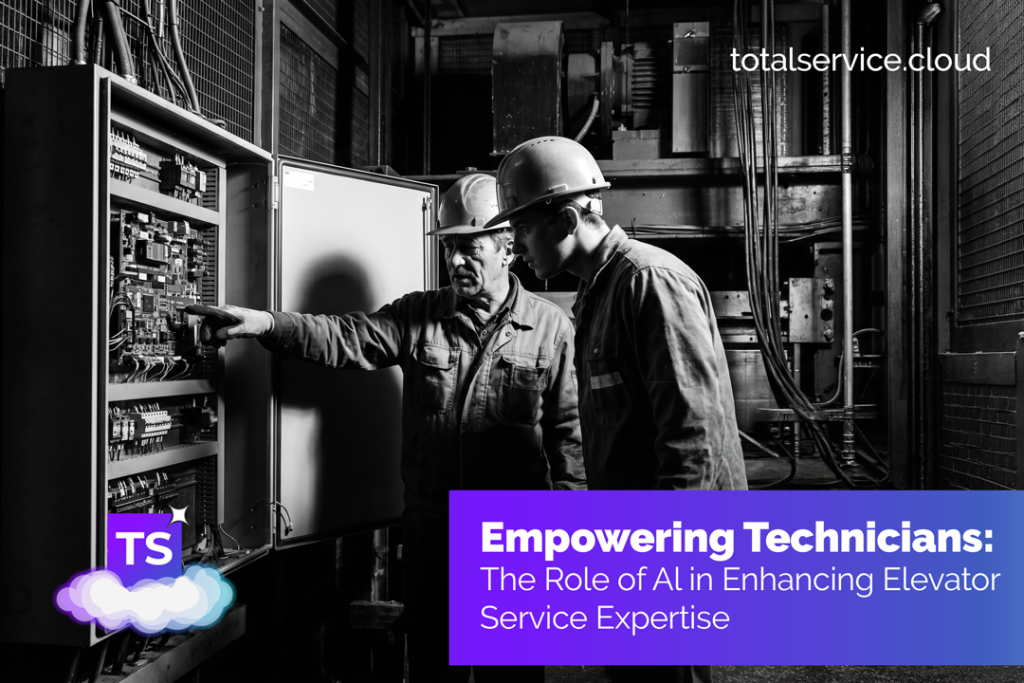
A senior mechanic with three decades of experience hangs up his tools. A second-year apprentice inherits part of his callback list. The controllers, the modernization history, the building quirks, the customer relationships: most of it lived in the senior tech’s head. Now it does not. This is where AI for elevator technicians earns its place. AI for elevator technicians is essential for bridging the knowledge gap between experienced and novice technicians.
This story plays out in shops across North America every month, and it is the single most expensive problem in elevator service today. It is also the clearest opportunity. AI for elevator technicians, used well, is not a replacement for the mechanic at the top of the ladder. It is a way to preserve what that mechanic knows and put it in the hands of the next generation, ensuring that AI for elevator technicians is effectively utilized.
The trade is at a turning point. The U.S. Bureau of Labor Statistics counts about 24,200 elevator and escalator installers and repairers as of 2024, with roughly 2,000 openings projected each year through 2034, including new positions, retirements, and workers leaving the field. The workforce is not getting younger or larger fast enough on its own.
The integration of AI for elevator technicians will play a crucial role in shaping how the next generation of technicians learns and grows in the industry.
Why technicians are out-adopting executives
The signal in the data is striking. In a late-2025 industry survey covered by Elevator World, 33% of technicians said they actively use AI tools in their work, compared with about 20% of service companies and just 14% of consultants. Field-level adoption is running ahead of the executive suite.
That should not surprise anyone who has spent time on a callback. Technicians live with the ambiguity of broken equipment every day. When a tool helps solve a problem in 20 minutes that used to take 90, they use it. They do not wait for a memo.
There is a risk in that pattern for service companies. If a shop does not offer technicians a sanctioned, trustworthy AI workflow, technicians will improvise with consumer tools. There is no audit trail. There is no customer-data protection. And the team’s collective knowledge stays trapped on individual phones instead of building into a shared asset for the company.
What AI for Elevator Technicians Actually Does in the Field
The benefits of AI for elevator technicians extend beyond individual tasks; it’s about fostering a culture of continuous learning and improvement.
The same Elevator World survey asked technicians where they want AI to help. Their priorities were practical: troubleshooting guidance (28%), training and upskilling (24%), and code and regulation reference (21%). They are not asking for moonshots. They are asking for a digital wrench.
In daily field work, AI shows up in four useful ways:
-
- Faster diagnostics on unfamiliar equipment. Pattern-matching across thousands of similar work orders narrows the likely causes before the technician opens a panel.
- Plain-language code and regulation lookup. Instead of paging through binders in a machine room, a technician asks a question and gets a cited answer.
AI for elevator technicians streamlines the process and helps in decision-making.
- On-the-job training. A first-year apprentice can ask follow-up questions without interrupting a senior mechanic on the other side of town.
- Knowledge capture. Every closed work order becomes a teachable example for the next person who works on the same building.
None of this replaces the technician’s eyes, ears, or hands. It changes what the technician has to remember unaided. The work still happens in the machine room. The judgment still belongs to the human at the panel.
In fact, the role of AI for elevator technicians is to augment, not replace, the vital skills and experience technicians bring to the job.
How does AI handle the knowledge that retires with a senior mechanic?
This is the single most expensive problem in the trade, and the one where AI has the clearest role. The International Union of Elevator Constructors represents more than 30,000 members across the United States and Canada, and a meaningful share of that workforce is closer to the end of a career than the start. Workforce data from 2023 puts the average age of a U.S. elevator installer or repairer at roughly 42.
KONE’s senior vice president of research and development, Johannes Rastas, has described the opportunity well: the deep tacit knowledge that technicians acquire through years of experience can be transformed into organizational knowledge, accessible to colleagues across the world and to AI counterparts as well. The senior mechanic does not disappear from the picture. The senior mechanic’s hard-won troubleshooting habits get documented, structured, and made searchable.
In practice, this plays out three ways:
Additionally, AI for elevator technicians helps in creating a more structured approach to knowledge sharing within teams.
- Service notes, photos, and decisions get captured at the point of work, then become searchable for the next technician on the same equipment.
- The platform suggests likely root causes based on prior outcomes for similar units, similar callbacks, and similar symptoms.
- The phrase “Bob always checks the door operator first on these” becomes a documented diagnostic step that survives Bob’s retirement.
One important caveat. Heikki Mannila, professor of computer science at Aalto University in Finland, has pointed out that service work involves physical objects with real material behavior. Service AI has to be physics-informed, in his phrase, and grounded in how parts and equipment actually behave. A general-purpose chatbot is not enough for safety-critical work.
The OEM advantage, and why independents can close the gap
Large OEMs have been visible about their AI investments. In April 2026, TK Elevator announced an agentic AI deployment on Microsoft Azure designed to give technicians real-time access to a global technical database alongside customer-specific elevator data. The company maintains roughly 1.4 million units in more than 100 countries, so the scale of training data behind that system is significant.
This allows AI for elevator technicians to provide insights that can lead to safer and more efficient service.
The honest reality for independent contractors: those proprietary platforms work on OEM equipment, inside OEM service contracts. They are not built to help an independent service shop work across mixed portfolios of controllers, drives, and modernization vintages.
The opportunity for independents is industry-specific software built around the actual workflows of independent elevator service. That includes:
- Unit-level service history that travels with the technician on a mobile device.
- Offline access in machine rooms and shafts where connectivity drops out.
- Structured data capture that turns every work order into part of the shared knowledge base.
- Mixed-brand coverage, because a real route includes everything from a relay panel installed in the 1980s to a current microprocessor controller.
A well-designed service platform is the foundation. AI sits on top of that foundation and gets smarter as the work history grows. Without the foundation, AI has nothing reliable to learn from.
What to look for before you adopt
In choosing a platform, consider how AI for elevator technicians can integrate with your existing systems to enhance overall efficiency.
Adoption decisions are easier when the evaluation criteria are clear. A practical checklist for an independent contractor weighing AI tools or AI-enabled service platforms:
-
- Mixed-brand coverage. Will the tool actually help on the equipment in your route, or only one manufacturer’s product line?
- Integration with service history. Does the AI draw on your shop’s own work orders and asset records, or does it ask technicians to re-enter context every time?
- Offline operation. Machine rooms and shafts are not friendly to cell signal. The tool has to work where the technician works.
Ultimately, the goal is to leverage AI for elevator technicians to empower the workforce and improve service outcomes.
- Audit trail. Who saw the data, what did the AI recommend, what did the technician actually do, and can the company reconstruct that record if a callback turns into a claim?
- Technician trust. The same Elevator World survey identified data privacy and worker surveillance as real concerns among technicians and service companies. A tool that feels like a productivity tracker will not get used. A tool that feels like a smarter clipboard will.
The right answer is not the flashiest demo. It is the platform a technician will actually open at 6:45 a.m. on a callback.
A workforce multiplier, not a replacement
The elevator trade still rewards the things it has always rewarded: judgment, mechanical intuition, safe hands, and the experience to know when something does not feel right. None of that is going away.
What is changing is what a technician has to carry, unaided, on every job. AI for elevator technicians, applied with care, takes the weight of memorized service history off the individual and puts it into a system the whole shop can draw on. The senior mechanic gets to work on harder problems instead of answering the same diagnostic question for the fifth time this week. The apprentice gets to learn faster without slowing the senior mechanic down. The company gets to keep its institutional knowledge when people retire.
This integration of AI for elevator technicians not only enhances productivity but also ensures that the wealth of knowledge does not retire with seasoned professionals.
That is what empowerment looks like in practice. Not a robot in a hard hat. A technician with better tools.
Talking through what this looks like for your shop
Every elevator service company is at a different point with AI for elevator technicians. Some are exploring. Some are already piloting. Some are weighing the risks before they move. A short conversation can help clarify where AI fits into your workforce strategy, where it does not, and what to look for in a platform built around the way independent contractors actually work.
Understanding the potential of AI for elevator technicians can lead to improved training programs and better service delivery.
Learn more about the platform purpose-built for independent elevator contractors on the TS Cloud overview, or reach out to Robert Guadalupe at Total Service to discuss how AI can support your team.