
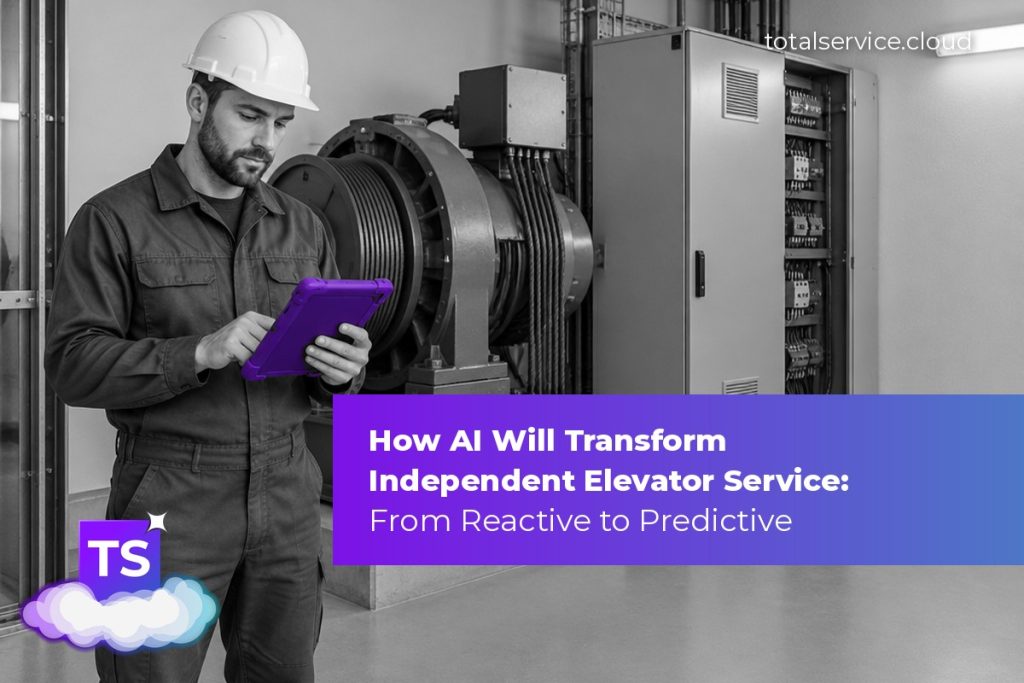
For independent elevator service companies, AI will not look like robots replacing mechanics. It will look like smarter dispatch, earlier warnings and service calls that happen before the breakdown. This is part 3 of our series on AI and the elevator industry. Part 1 looked at where the industry stands today, and part 2 covered what the major manufacturers are doing with AI. Here we look at what changes for independent contractors.
The core shift: reactive to predictive
The traditional elevator service model is reactive. A unit fails, a call comes in, a mechanic is dispatched, and the right parts may or may not be on the truck.
Predictive service works the other way around. Equipment and service data are analyzed for early warning signs, so a problem can be scheduled for repair before it becomes an outage. The kinds of patterns this work looks for include:
- Door cycle anomalies that point to operator or motor wear
- Motor temperatures trending toward overheating
- Brake wear patterns that come before a failure
- Controller fault codes that tend to precede outages
As part 2 showed, the large manufacturers already run predictive services on their own connected equipment. Independent contractors with mixed fleets need their own data to do the same.
AI dispatch
Dispatch is one of the largest sources of lost time for independent elevator companies. Mechanics are often routed by availability and geography, without one view of every factor that matters. AI dispatch tools aim to weigh several of those factors at once:
- Mechanic location and skills relative to the job
- Parts on the assigned truck
- Contract priority and how urgent the call is
- Route efficiency across the full day
The payoff is fewer wasted trips, less overtime and better use of each mechanic’s day.
Help for mechanics on site
Mechanics spend real time on the phone with the office or searching documentation while on site. Field-facing AI tools can help them interpret controller error codes, find the right documentation for the unit, suggest repair steps based on similar past jobs, and flag parts that may be needed before they leave the shop. That narrows the gap between experienced and newer mechanics and shortens the time to finish a job.
Modernization planning with data
Finding modernization candidates is still one of the most manual parts of the elevator business. Sales teams rely on relationships, visual inspections and judgment. With structured data, the same decision can draw on:
- Equipment age and expected remaining service life
- Service call frequency and cost per unit over time
- Building use patterns that wear components faster
- Maintenance cost trends that signal an approaching replacement point
That gives the modernization pipeline a basis in data, not only in relationships.
Why clean data comes first
None of these capabilities work without clean, structured operational data. Predictive models are only as good as the service history they learn from, and dispatch tools only work when work orders, mechanics and equipment live in one system. The starting point for AI readiness is not an AI tool. It is a platform that captures complete, accurate data on every job, every mechanic and every unit you maintain.
Where TS Cloud is today
TS Cloud already captures that foundation. It creates work orders automatically, keeps unit records with make, model, age and modernization history, shows mechanics a unit’s service history in the mobile app before a visit, and tags callbacks by type and cause so they can be reported by unit, route and mechanic.
AI features are live in the product now. The TS Cloud AI Assistant answers questions and takes commands in plain English or by voice, the AI Report Builder turns a plain-English description into a report, and Technician Assist lets mechanics search service and knowledge documentation and get a synthesized answer. See the full list on the TS Cloud AI page.
Predictive failure models and modernization recommendations are on the roadmap for Ellie, the TS Cloud AI assistant, and IoT sensor connections are on the TS Cloud roadmap. Neither has a release date yet.
Frequently asked questions
How will AI change independent elevator service companies?
AI will shift elevator service from reactive to predictive: smarter dispatch, earlier warnings from equipment and service data, help for mechanics on site, and modernization planning based on data.
What is predictive elevator maintenance?
Predictive maintenance analyzes equipment and service data for early warning signs, such as door cycle anomalies, rising motor temperatures, brake wear patterns or controller fault codes, so repairs can be scheduled before an outage.
What do elevator contractors need before using AI?
Clean, structured operational data. Predictive models learn from service history, and dispatch tools need work orders, mechanics and equipment in one system, so the first step is a platform that captures complete data on every job and unit.
Which AI features are live in TS Cloud today?
Live features include the TS Cloud AI Assistant, the AI Report Builder and Technician Assist, among others listed on the TS Cloud AI page. Predictive failure models and modernization recommendations are on the roadmap for Ellie, with no release date yet.
Build your data foundation
TS Cloud is built for independent elevator contractors, and for HVAC and specialty contractors. It keeps dispatch, service history by unit and work orders in one system, so your data is ready as AI tools mature. Book a TS Cloud demo.